Nucleotides - the building blocks of life

The most important facts at a glance
Nucleotides: effect, function & structure
Entdecke ihre vielfältige Wirkung, ihre wichtigen Funktionen und ihren komplexen Aufbau. Tauche ein in die Welt der Nukleotide und erfahre, wie sie genetische Informationen speichern, die Genexpression regulieren und zum Wohlbefinden beitragen können.
Learn more
Nucleotides and the gut: influence on gut health
Der Darm ist ein wichtiger Bestandteil unserer Gesundheit. Erfahre, wie Nukleotide die Darmgesundheit unterstützen und zur Stärkung des Immunsystems beitragen können.
Learn more
Nucleotides: All experiences at a glance
Betrachte die Erfahrungen von Anwendern auf einen Blick und erfahre, wie die Bausteine des Lebens dazu beitragen können, das Immunsystem zu stärken, Entzündungen zu reduzieren und die Regeneration von Gewebe zu fördern.
Learn more
Taking nucleotides: How to do it right
Lerne, wie du Nukleotide richtig einnehmen kannst, um ihre volle Wirkung zu entfalten. Entdecke die verschiedenen Darreichungsformen und ihre spezifischen Anwendungen.
Learn more
Nukleotide sind die grundlegenden Bausteine des Lebens und spielen eine entscheidende Rolle bei der Übertragung genetischer Informationen, der Speicherung von Erbinformationen und der Regulation der Genexpression. In diesem Guide befassen wir uns eingehend mit den verschiedenen Aspekten und Funktionen von Nukleotiden, darunter ihre Wirkung und ihr Aufbau.
Wir untersuchen außerdem ihre Bedeutung für den Darm und wie sie sich auf die Darmgesundheit auswirken können. Darüber hinaus setzen wir uns mit den unterschiedlichen Erfahrungen von Menschen auseinander, die Nukleotide einnehmen. Abschließend gehen wir näher auf die verschiedenen Möglichkeiten der Einnahme und ihre Auswirkungen auf den Körper ein. Dieser Guide soll dein Verständnis für Nukleotide vertiefen und dir dabei helfen, fundierte Entscheidungen für deine Gesundheit und dein Wohlbefinden zu treffen.
Nucleotides: effect, function & structure
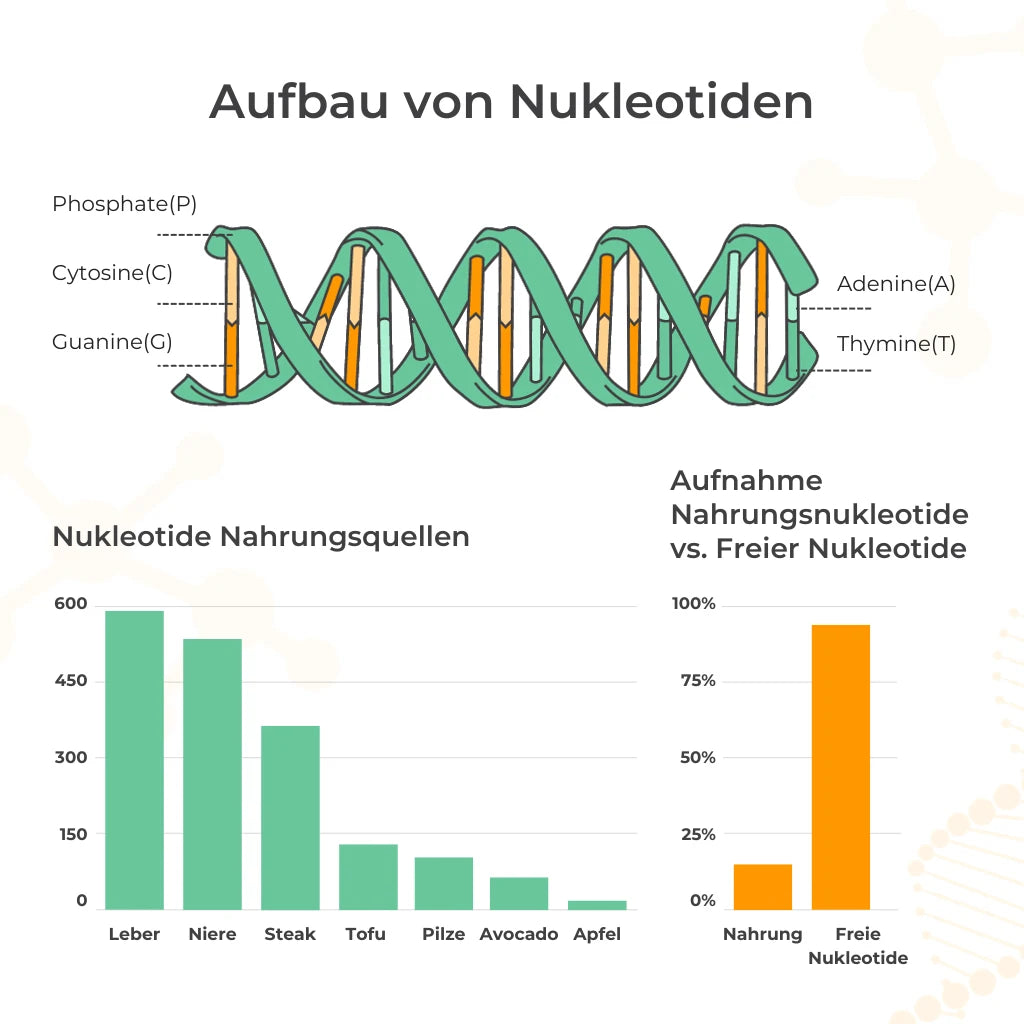
Nukleotide sind die Grundbausteine von DNA und RNA, die unsere genetischen Informationen enthalten. Sie bestehen aus drei Teilen: einer Base, einem Zuckermolekül und einer Phosphatgruppe. Entscheidend ist, dass jedes Nukleotid innerhalb der DNA einen bestimmten Teil der Information im DNA-Molekül trägt.
Bei der DNA-Replikation besitzt jede Base eine komplementäre Base. Die vier Basen sind Adenin (A), Guanin (G), Cytosin (C) und Thymin (T) in der DNA beziehungsweise Uracil (U) in der RNA. Der Zucker ist entweder Ribose bei RNA oder Desoxyribose bei DNA. Die Phosphatgruppe ist ein Molekül aus Phosphor und Sauerstoff, das an das Zuckermolekül gebunden ist.
Nukleotide erfüllen lebenswichtige Funktionen in den Zellen. Sie spielen eine wichtige Rolle bei der Übertragung von Signalen und bei der Energiegewinnung. Beispielsweise ist ATP, kurz für Adenosintriphosphat, ein Nukleotid, das als universeller Energieträger in den Zellen dient. Es wird bei zahlreichen Stoffwechselprozessen in Energie umgewandelt und liefert den notwendigen Antrieb für zelluläre Prozesse.
Nukleotide sind nicht nur für die Zellteilung und den Energiestoffwechsel in den Mitochondrien unerlässlich, sondern auch für den Aufbau von Fetten und Kohlenhydraten. Ohne sie wäre unser Körper nicht in der Lage, wichtige Prozesse durchzuführen, die für das Überleben notwendig sind. Dazu gehört unter anderem die Zellteilung, die für das Wachstum und die Reparatur von Gewebe und Organen verantwortlich ist.
Nukleotide sorgen außerdem dafür, dass Proteine besser aufgenommen und transportiert werden. Sie unterstützen das Immunsystem, indem sie die Produktion von Antikörpern fördern, und tragen zur Zellerneuerung bei, die für gesundes Gewebe wichtig ist.
Darüber hinaus sind Nukleotide essenziell für die DNA-Replikation und die Proteinbiosynthese. Bei der DNA-Replikation werden die beiden Stränge der DNA-Doppelhelix getrennt. Jeder einzelne DNA-Strang dient anschließend als Vorlage für den Aufbau eines neuen Strangs. Bei der Proteinbiosynthese wird die Information der DNA in RNA umgeschrieben, die anschließend als Vorlage für die Herstellung von Proteinen dient.
Nukleotide spielen auch eine wichtige Rolle bei der Diagnose und Behandlung von Infektionskrankheiten und Krebs. Durch ihre genetische Analyse können spezifische Mutationen und Abweichungen identifiziert werden, die auf Krankheiten hinweisen können. Auf Grundlage dieser Informationen lassen sich personalisierte Therapien entwickeln, die auf den individuellen genetischen Hintergrund zugeschnitten sind. Hier kannst du mehr über die Wirkung, Funktion und den Aufbau von Nukleotiden erfahren.
Here are some vegan food supplements that contain nucleotides


Nucleotides and the gut
Nukleotide sind zahlreich im Darm zu finden, da dieser Teil des Verdauungstrakts für den Abbau von Nahrungsmitteln und die Aufnahme von Nährstoffen verantwortlich ist. Einige Nukleotide, beispielsweise Adenosinmonophosphat (AMP) und Guanosinmonophosphat (GMP), werden durch den Abbau von Nukleinsäuren aus der Nahrung freigesetzt.
Diese Nukleotide erfüllen verschiedene Funktionen im Darm. Zum einen dienen sie als Energiequelle für die Darmzellen und unterstützen deren normale Funktion. Darüber hinaus können sie die Darmgesundheit fördern, indem sie das Wachstum und die Aktivität nützlicher Darmbakterien stimulieren. Diese Bakterien sind wichtig für die Verdauung, die Aufnahme von Nährstoffen und die Abwehr krankheitserregender Keime. Das kann beispielsweise zur Aufrechterhaltung eines gesunden Gewichts beitragen.
Außerdem kann die Zufuhr von Nukleotiden die Zusammensetzung der Darmflora positiv beeinflussen. Sie können die Darmbarriere stärken und Entzündungen im Darm reduzieren. Durch diese vielfältigen Wirkungen können Nukleotide zur Verbesserung der Darmgesundheit beitragen. Sie können in Form von Nahrungsergänzungsmitteln aufgenommen werden, um den Nukleotidbedarf des Darms zu decken und seine normale Funktion zu unterstützen. Weitere Informationen findest du in unserem Artikel über die Bedeutung von Nukleotiden für den Darm.
The intake of nucleotides can also have a positive effect on the composition of the intestinal flora. Nucleotides can also strengthen the intestinal barrier and reduce inflammation in the intestine. Thanks to these diverse effects, nucleotides can contribute to improving intestinal health. They can be taken in the form of food supplements to cover the intestine's nucleotide requirements and support intestinal function.
For more information, you can read our article on the importance of nucleotides in the gut in the gut.

Vegan supplements for weight control that contain nucleotides


Nucleotides: Experience
Viele Anwender berichten von positiven Erfahrungen mit Nukleotiden als Ergänzung ihrer Ernährung. Sie betonen vor allem die unterstützende Wirkung auf das Immunsystem und die Verbesserung des Energieniveaus. Letzteres wird insbesondere von Sportlern geschätzt.
Einige berichten außerdem von einer verbesserten Verdauung und einer schnelleren Erholung nach körperlicher Anstrengung. Andere nehmen eine positive Wirkung auf die Muskelregeneration und den Muskelaufbau wahr. Nukleotide unterstützen die Reparatur von Muskelgewebe nach körperlicher Anstrengung und fördern das Wachstum von Muskelzellen. Viele Anwender empfehlen eine regelmäßige Einnahme, um optimale Ergebnisse zu erzielen.
Trotz ihrer wichtigen Funktionen sollte die Einnahme mit Bedacht erfolgen. Die Verwendung von Nahrungsergänzungsmitteln im Allgemeinen und von nukleotidhaltigen Präparaten im Besonderen sollte während oder nach einer medizinischen Behandlung mit dem behandelnden Arzt abgestimmt werden. Weitere Hintergründe und Einblicke findest du in unserem Beitrag Nukleotide: Erfahrungen.
Experiences of our customers
"As a vegan, endurance athlete and iron-man triathlete, I have a special need for nutrients for my body and am constantly on the lookout for healthy and energy-boosting ingredients that are healthy for my body and, very importantly for me personally, are also natural!"
Taking nucleotides
Nukleotide können auf verschiedene Weise aufgenommen werden: über die Nahrung oder in Form von Nahrungsergänzungsmitteln. Sie kommen in zahlreichen Lebensmitteln vor, insbesondere in proteinreichen Lebensmitteln wie Fleisch, Fisch, Eiern und Hülsenfrüchten.
Vegana Natura arbeitet mit einem renommierten Schweizer Forscher zusammen, der seit mehr als 30 Jahren mit Nukleotiden forscht. Gemeinsam wurden hochwertige, vegane Produkte entwickelt, die unter anderem als Kapseln und Pulver erhältlich sind. Die empfohlene Dosierung hängt von verschiedenen Faktoren ab, darunter Alter, Geschlecht und Gesundheitszustand.
Möchtest du weitere Informationen zur Anwendung erhalten? Dann lies unseren Artikel Nukleotide einnehmen und erfahre, in welchen Lebensmitteln sie vorkommen und welche weiteren Möglichkeiten der Zufuhr es gibt.
More matching blog articles on the topic of nucleotides



Frequently asked questions about nucleotides
Nukleotide spielen eine entscheidende Rolle in der Zelle. Sie dienen als Bausteine der DNA und RNA, die unsere genetischen Informationen speichern. Außerdem sind Nukleotide für die Übertragung chemischer Energie in Form von Adenosintriphosphat (ATP) verantwortlich und an verschiedenen Prozessen der Signalübertragung beteiligt.
DNA (Desoxyribonukleinsäure) und RNA (Ribonukleinsäure) sind beides Nukleinsäuren, unterscheiden sich jedoch in einigen Punkten. DNA enthält den Zucker Desoxyribose und die Basen Adenin, Thymin, Cytosin und Guanin. RNA enthält hingegen Ribose sowie die Basen Adenin, Uracil, Cytosin und Guanin.
Nukleotide kommen in vielen Lebensmitteln vor, insbesondere in proteinreichen Lebensmitteln wie Fleisch, Fisch, Eiern und Milchprodukten. Auch Hülsenfrüchte, Nüsse, Samen, Hefeextrakt und Bierhefe enthalten Nukleotide. Alternativ sind sie als Nahrungsergänzungsmittel erhältlich. Je nach persönlicher Vorliebe kommen dafür beispielsweise Nukleotide Kapseln oder flexibel verwendbares Nukleotide Pulver infrage.
Der Aufbau der Nukleotide folgt grundsätzlich demselben Prinzip: Nukleotide bestehen aus einem Zucker, einer Phosphatgruppe und einer Base. Die vier Basen der DNA sind Adenin (A), Guanin (G), Cytosin (C) und Thymin (T). In der RNA wird Thymin durch Uracil (U) ersetzt.
Ein Mensch hat etwa drei Milliarden Nukleotide in jeder einzelnen Zelle. Der Körper eines erwachsenen Menschen besteht aus zahlreichen Zellen. An diesen Zahlen wird deutlich, welche wichtige Bedeutung die kleinen Moleküle für unseren Körper haben.
JNukleotide sind über sogenannte Phosphodiesterbindungen miteinander verknüpft. Dabei verbinden die Phosphatgruppen die Zuckermoleküle benachbarter Nukleotide miteinander, wodurch eine lange Nukleotidkette entsteht.
Our conclusion
Nucleotides form the framework of DNA and RNA, which contain our genetic information. The structure of nucleotides is made up of three components: a base, a sugar and a phosphate group. The four different bases are adenine (A), guanine (G), cytosine (C) and thymine (T) in DNA or uracil (U) in RNA. The sugar can be either ribose (in RNA) or deoxyribose (in DNA). The phosphate group is a molecule that consists of phosphorus and oxygen and is bound to the sugar molecule.
Nucleotides are important for the health and well-being of the body. For example, they are essential for cell division, energy metabolism and the breakdown of fats and carbohydrates. They also help with the absorption and transport of proteins, strengthen the immune system, support cell renewal and are crucial for DNA replication and protein synthesis.
Interestingly, they are abundant in the gut. Here they serve as an energy source for intestinal cells and can promote intestinal health by stimulating the growth and activity of beneficial intestinal bacteria. They can also strengthen the intestinal barrier and reduce inflammation in the gut.
Taking nucleotides through food or supplements can therefore have a positive effect on the immune system, energy levels, digestion and muscle regeneration. They are suitable for athletes, vegans and vegetarians, people of an older age and people who simply value their health. However, it is important to consult a doctor or nutritionist before taking nucleotide supplements, as excessive intake can lead to side effects.
