
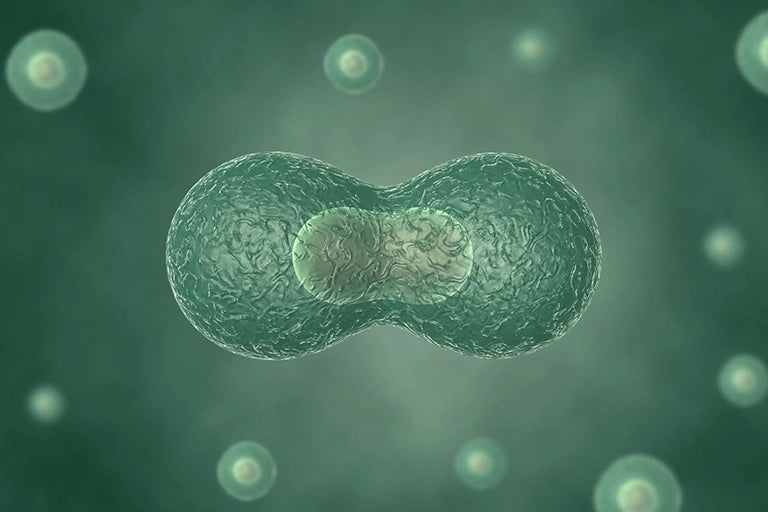
Cell Division and Cell ReplicationBefore each mitosis (cell division), DNA polymerase ensures that the entire gene strand is duplicated during replication. A vast pool of free nucleotides is absolutely essential for this process.
A nucleotide is the basic building block of nucleic acids such as DNA and RNA. It consists of a base, a sugar, and at least one phosphate group. Nucleotides also serve as energy carriers (ATP), signaling molecules (cAMP), and components of coenzymes (NAD⁺). The body can produce nucleotides on its own. During periods of increased demand, nucleotides from the diet are considered conditionally essential.
Before each cell division, the entire genome must be replicated, a process that requires billions of nucleotides. According to one estimate, the body of an adult consists of about 30 trillion cells, of which approximately 330 billion are replaced daily—mostly blood cells (Sender & Milo 2021). Each new cell requires nucleotides as building blocks for this process.
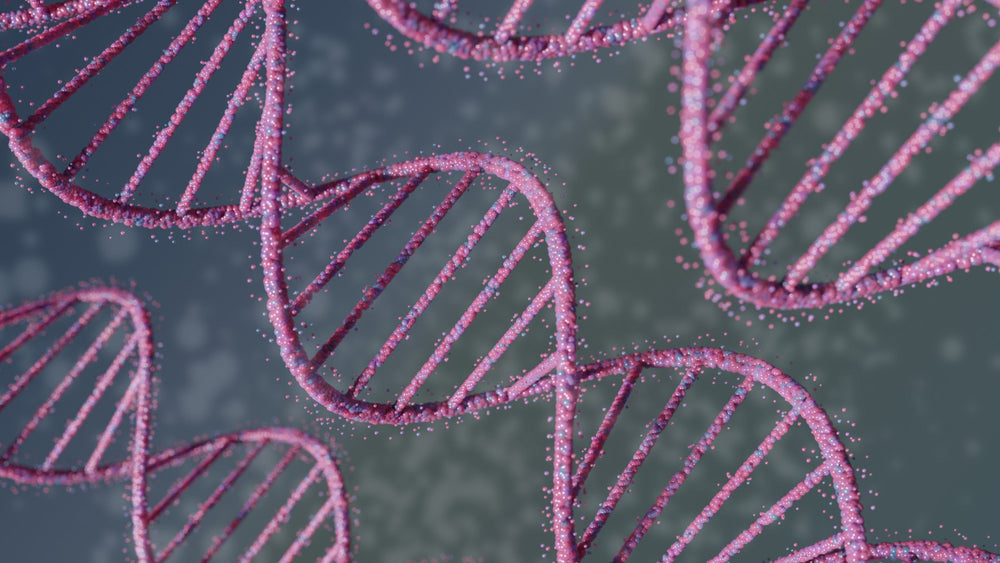
DNA and RNA— The Stores of Information
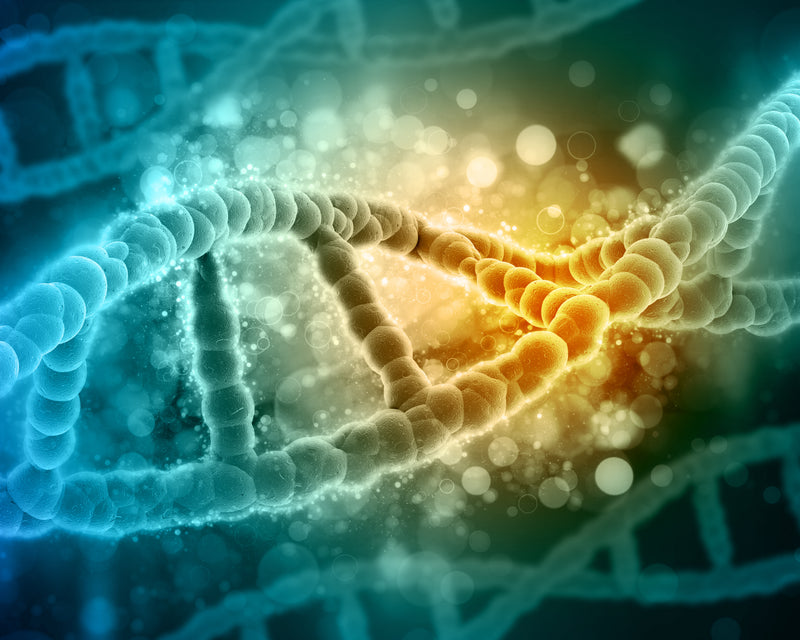
DNA (deoxyribonucleic acid), which has a double-helix structure, contains the cell's blueprint and consists of nucleotides containing deoxyribose and the bases A, G, C, and T. RNA (ribonucleic acid) is usually single-stranded, contains ribose and uracil instead of thymine, and transmits information from DNA, converting it into proteins.
More on the topic of cellular aging: Longevity.
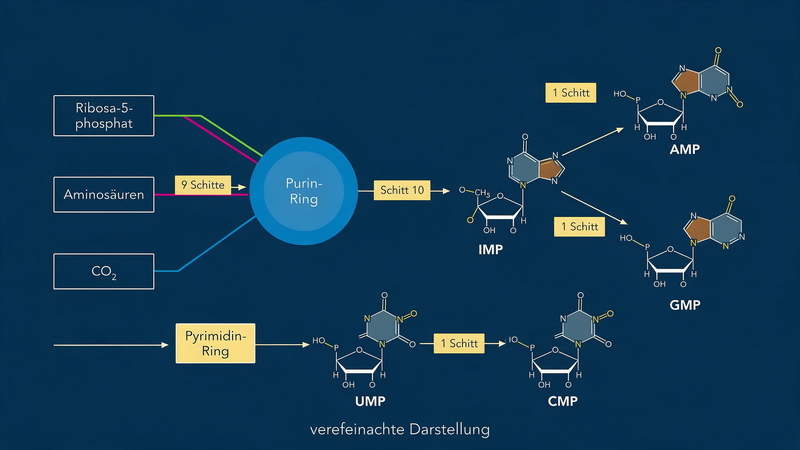
The body can produce nucleotides on its own through de novo synthesis. In certain situations—such as during growth, injury, or infection—the body’s need for nucleotides increases, and nucleotides from food are considered conditionally essential. Review of nucleotides as conditionally essential nutrients: The extent to which supplemental intake is effective has not been conclusively established by science. The data come primarily from studies of infants as well as from animal and laboratory experiments.
Sources of nucleotides in the body:
Review Article on Nucleotide Metabolism


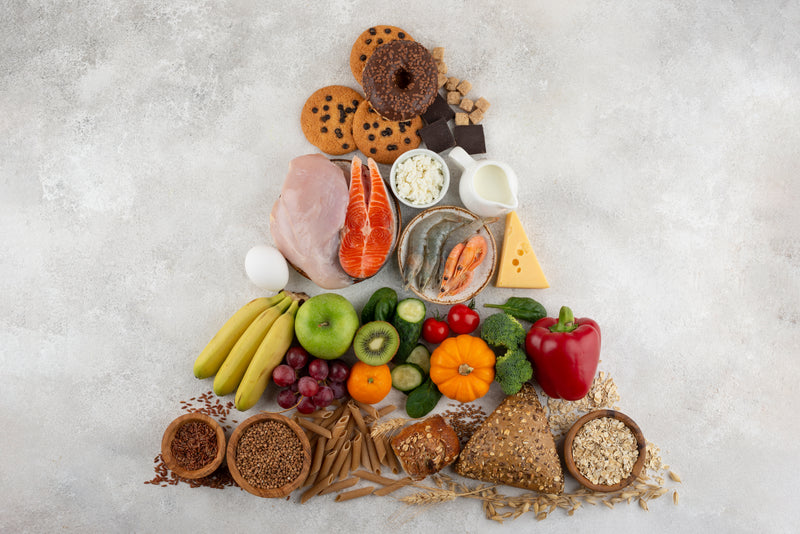
Nucleotides occur naturally in milk. The highest levels were measured immediately after birth, in both cow’s milk and human milk, and concentrations gradually decrease over the course of breastfeeding (Schlimme et al. 2000). Human milk is considered the best source of nucleotides for young infants (Uauy et al. 1994).
These findings apply to infants and cannot be generalized to adults. Dietary supplements are not a substitute for breast milk or infant formula and are not intended for infants.

Each nucleotide plays a specific role in cell structure.

A building block of RNA and a precursor to ADP and ATP, the cell's universal energy carrier. As cAMP, it also acts as a signaling molecule.
Adenine Base (Purine)
A building block of RNA. Uridine nucleotides are involved in carbohydrate metabolism and serve as precursors for cytidine nucleotides.
Uracil Base (Pyrimidine)
A building block of RNA. Cytidine nucleotides are involved in the formation of membrane lipids (phospholipids).
Base Cytosine (Pyrimidine)
A building block of RNA. GTP provides energy for protein synthesis, and cGMP serves as a messenger molecule in signal transduction.
Guanine Base (Purine)
Key intermediate step in purine metabolism: AMP and GMP are formed from IMP.**
Base Hypoxanthine (Purine)The key difference lies in the phosphate group: Chemically, a nucleoside consists only of a nitrogen-containing nucleobase and a pentose sugar (ribose or deoxyribose). Only when at least one phosphate group is added to this molecule through enzymatic phosphorylation does a biologically active nucleotide (such as AMP, ADP, or ATP) form, which serves as a building block for DNA and RNA.
Yes. All cells can synthesize nucleotides de novo from simple building blocks, but this process is energy-intensive. Intestinal and immune cells can do this only to a limited extent and additionally utilize recycled nucleotides (salvage pathway) and nucleotides from food.
A nutrient is considered conditionally essential if the body can normally produce it on its own, but the body’s need for it increases in certain situations, such as during growth, injury, or infection. This is a topic of debate in the scientific literature with regard to nucleotides (Hess & Greenberg 2012).
The cells of the intestinal mucosa are among the body’s most rapidly renewing tissues. Review articles describe nucleotides as important for the development, maturation, and repair of the gastrointestinal tract (Uauy et al. 1994). The evidence comes primarily from studies of infants and animals; meaningful studies in healthy adults are largely lacking. Learn more on the Gut Health page.
Immune cells such as lymphocytes multiply rapidly during an immune response and have only a limited ability to synthesize nucleotides on their own (Uauy et al. 1994). Review articles describe dietary nucleotides as important for the cellular immune response (Kulkarni et al. 1994). Whether supplemental intake provides benefits for healthy adults has not been conclusively proven. Learn more on the Immune System page.
The salvage pathway is a recycling process: Instead of synthesizing nucleotides from scratch, the body reuses free purine and pyrimidine bases from degraded DNA and RNA. This conserves energy (ATP).
Nucleotides store chemical energy in their high-energy phosphate bonds. ATP is the cell’s universal energy currency; when a phosphate group is released to form ADP, energy is released for muscle activity and metabolism. GTP provides the energy for protein synthesis at the ribosomes.
They are not recommended—or should only be used after consulting a doctor—for people with gout or elevated uric acid levels, those with a yeast allergy, those who have undergone organ transplants, those taking immunosuppressive medications, pregnant or breastfeeding women, and those taking medication on a regular basis.
The following studies examine nucleotides as a class of compounds, not as products of Vegana Natura. Most of the data on dietary nucleotides come from studies of infants, as well as from animal and laboratory experiments. Meaningful studies involving healthy adults are rare and small in scale. These studies serve to provide scientific context and should be considered independently of dietary supplements.
Sender R, Milo R (2021). The distribution of cellular turnover in the human body. Nature Medicine 27:45–48. DOI
Study type: Estimation based on existing data. The authors estimate the number of cells in the body of an adult reference male to be approximately 30 trillion and the daily cell turnover to be approximately 330 billion cells. About 90% of these are blood cells. Blood cells and intestinal epithelial cells account for the majority of the cell mass turned over.
Lane AN, Fan TW-M (2015). Regulation of mammalian nucleotide metabolism and biosynthesis. Nucleic Acids Research 43(4):2466–2485. PubMed
Study type: Review. Nucleotides are continuously synthesized de novo in all cells. When cells divide, the demand for DNA replication and RNA synthesis increases. Nucleotide synthesis is energy-intensive and is regulated at multiple levels.
Hess JR, Greenberg NA (2012). The role of nucleotides in the immune and gastrointestinal systems: potential clinical applications. Nutrition in Clinical Practice 27(2):281–294. PubMed
Study type: Review. Dietary nucleotides play an important role in rapidly dividing cells and are considered conditionally essential when demand is increased (e.g., during growth, injury, or infection). In infant formula, they have been reported to promote improved intestinal maturation and immune function. The authors consider statements regarding the specific benefits of individual nucleotides to be limited.
Uauy R, Quan R, Gil A (1994). Role of nucleotides in intestinal development and repair: implications for infant nutrition. Journal of Nutrition 124(8 Suppl):1436S–1441S. PubMed
Study type: Review. Rapidly growing tissues such as the intestinal epithelium and lymphatic cells have a limited ability to synthesize nucleotides on their own and require exogenous purine and pyrimidine bases. Nucleotides are considered important for the development, maturation, and repair of the gastrointestinal tract. Excess purines are broken down into uric acid. Breast milk is considered the best source of nucleotides for young infants.
Kulkarni AD, Rudolph FB, Van Buren CT (1994). The role of dietary sources of nucleotides in immune function: a review. Journal of Nutrition 124(8 Suppl):1442S–1446S. PubMed
Study type: Review. Dietary nucleotides appear to be important for the cellular immune response, particularly during periods of immunological stress.
Carver JD (1994). Dietary nucleotides: effects on the cellular immune system, the intestine, and the liver. Journal of Nutrition 124(1 Suppl):144S–148S. PubMed
Study type: Review (animal and infant data). In mice, a nucleotide-free diet was associated with weaker indicators of cell-mediated immunity. Infants fed breast milk or nucleotide-enriched formula showed higher NK cell activity at two months of age than infants fed unenriched formula.
Grimble GK (1994). Dietary nucleotides and gut mucosal defense. Gut 35(1 Suppl):S46–S51. PubMed
Study type: Review. The gut relies on a supply of nucleotides that are synthesized anew in the liver. Humans adapt their endogenous synthesis to the supply from the diet.
Schlimme E, Martin D, Meisel H (2000). Nucleosides and nucleotides: natural bioactive substances in milk and colostrum. British Journal of Nutrition 84(Suppl 1):S59–S68. PubMed
Study type: Review (nucleotide content in milk). Nucleotides, nucleosides, and nucleobases belong to the non-protein nitrogen fraction of milk. The highest levels were measured immediately after birth, in both cow’s milk and human milk. The concentrations of most nucleosides and nucleotides gradually decrease over the course of lactation.
Gutiérrez-Castrellón P et al. (2007). Immune response to nucleotide-supplemented infant formulae: systematic review and meta-analysis. British Journal of Nutrition 98(Suppl 1):S64–S67. DOI
Study type: Systematic review with meta-analysis (infant formula). The meta-analysis included 15 studies. Compared with breast milk or control formula, nucleotide-enriched infant formula was associated with better antibody responses to vaccinations (Hib, diphtheria, polio), with greater effects observed at higher intake levels.
Hawkes JS, Gibson RA, Roberton D, Makrides M (2006). Effect of dietary nucleotide supplementation on growth and immune function in term infants. European Journal of Clinical Nutrition 60(2):254–264. Full text
Study type: randomized controlled trial, infants. In this study, 200 healthy infants received formula containing 33.5 mg/L or 10 mg/L of nucleotides. Growth and immune markers did not differ after 7 weeks. After 7 months, antibody levels against the tetanus vaccine were higher in the nucleotide group; there was no difference in antibody levels against Hib. The authors describe the improvement as modest.
Singhal A et al. (2008). Dietary nucleotides and fecal microbiota in formula-fed infants: a randomized controlled trial. American Journal of Clinical Nutrition 87(6):1785–1792. PubMed
Study type: randomized controlled trial, infants. In one subgroup (mean age 20 weeks), 35 infants received a nucleotide-enriched formula (31 mg/L) and 37 received a control formula. Forty-four breastfed infants served as a reference group. In stool samples, the ratio of the Bacteroides group to Bifidobacteria was lower in the nucleotide group than in the control group. The authors interpret this as evidence that nucleotides have a beneficial effect on the gut microbiota of formula-fed infants.
Ostojic SM, Obrenovic M (2012). Sublingual nucleotides and immune response to exercise. Journal of the International Society of Sports Nutrition 9:31. DOI
Study type: double-blind, placebo-controlled pilot study (short report), adults. Thirty-eight healthy men (ages 20–25) took 50 mg of nucleotides sublingually or a placebo for 14 days. In the nucleotide group, serum IgA and NK cells were higher, and the decline in salivary immunoglobulins after exercise was less pronounced. Limitations: small sample size, only young men, sublingual rather than oral administration.
Results from animal and laboratory studies cannot be readily applied to humans.
Ding T, Xu M, Li Y (2022). An overlooked prebiotic: beneficial effect of dietary nucleotide supplementation on gut microbiota and metabolites in Prone-8 mice with accelerated senescence. Frontiers in Nutrition 9:820799. PubMed
Study type: Animal study (mouse) and laboratory experiment. Mice fed a nucleotide-free diet had lower gut microbiota diversity than mice receiving nucleotide supplementation, and the metabolites in their feces also differed. In the laboratory experiment (in vitro), nucleotides promoted the growth of Lactobacillus casei.
Bueno J et al. (1994). Effect of dietary nucleotides on small intestinal repair after diarrhea. Histological and ultrastructural changes. Gut 35(7):926–933. PubMed
Study type: Animal study (rat). Chronic diarrhea was induced in weaned young rats by a lactose-rich diet. After recovery, the architecture and fine structure of the intestinal mucosa in animals fed a nucleotide-enriched diet were closer to those of healthy control animals. The authors consider it possible that nucleotides are important nutrients for the repair of the intestinal mucosa.
Note: These studies examine nucleotides as a class of compounds, not products from Vegana Natura. They do not constitute a claim regarding the efficacy of any product.
Nucleotides: The content explains the natural function of nucleotides in the human body. It is intended to provide a scientific framework for understanding biological processes and should be considered independently of dietary supplements. It does not constitute a health claim or a description of the effects of any product.
Statements in quotations reflect the personal professional opinion of the person quoted.
Dietary supplements are not a substitute for a balanced, varied diet and a healthy lifestyle.
